|
Electronic texts are like machines, composed of interlocking
words and images in time and space. This class will explore the schematics of
web-based narratives. After reading a range of exemplary works, students will
build some small narrative machines of their own: a map, a puzzle or a sculpture
and a machine of their choice.
See the Gallery for examples
of work by students on this course.
The tutor: Carolyn Guertin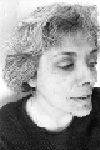
Carolyn Guertin is a poet and scholar of the new
media arts, specializing in the feminist avant-garde, at the University of Alberta,
Canada. Curator of Assemblage:
The Women's New Media Gallery and inhabiting a studio
at the trAce Online Writing Community, her own creative and critical works have
been published internationally in print and online. She is also a literary adviser
to the Electronic Literature Organization
http://www.ualberta.ca/~cguertin/
Next course starts Monday 8th April, fee £100
XE.com Personal Currency Assistant
Register for this course
New dates for this course will shortly be announced.
Please watch this space for details or join
our mailing list to be informed when the schedule comes out.
The aims of this course are:
- To create quality web-native literary works.
- To study the conjunction of word and image as means of
storytelling in any genre.
- To broaden understanding of the differences of the new
media arts from literature and film
Contents
We will look at a variety of forms that literary texts
can take in the new media and analyze them as digital machines. This will include
texts that map, texts that play games or set puzzles, sculptural works, and textual
machines.
Typical Reading
Suggested reading: a good overview of literary forms in
the new media. Janet Murray's Hamlet on the Holodeck, Michael Joyce's Of Two Minds
or Sarah Sloane's Digital Fictions are particularly recommended, but others like
Ilana Snyder's Hypertext or George Landow's Hypertext 2.0 will do. Students should
explore the Electronic Literature Directory, Webartery member listings and/or
Assemblage prior to starting class to familiarize themselves with the broad variety
of approaches to electronic writing
Learning Outcomes: By the end of this course you should:
- be proficient in creating web-based narratives in any
genre.
Typical assessments
- Students will create a text that is a map or a floorplan
and people it with character (animate or inanimate). Once it is mapped, they will
add 'conversation' or narrative and temporal elements.
- Students will devise a text that is a puzzle or simple
board game, OR students will create a text that is an online, multidimensional
sculpture.
- Students will create a machine of their own design.
Pre-requisites for this course
You will need to:
- be able to use a word processor
- be able to log on to the Internet
- be able to use a browser to surf the Web
- be able to send and receive email
- be able to design a web page
- have some experience at working with images (your own
or other people's)
- To get the most out of this course, you should have the
following software installed on your computer: Dreamweaver recommended, but FrontPage,
Storyspace or any other web design programs are okay. A 4+ browser is essential
and you will need some software suitable for manipulating and/or generating images.
|